Students at PRIS are running their own experiments. Students in middle school are collecting data on daily activity levels, nightly sleep, and emotions. Continue to check-in to see if practicing healthy habits has a positive influence on academic skills.
Want to know more? Check this out...
Naperville School District in Illinois, who experimented with a mandatory mile run at the very start of the school day, is a prime example. Kids in the Naperville School District not only outperformed neighboring districts, but whole countries. The eighth grade Naperville students that took the an international science test finished ahead of Singapore! As a comparison, U.S. students typically rank 18th in the world. They credit much of their academic results to a fitness-based physical education program. Yet only 6 percent of U.S. schools have physical education classes 5 times a week. In addition, 20 percent of U.S. elementary schools abolished recess in favor of increased classroom time to improve student achievement. Students who exercise, studies have shown, have better concentration and are better team players both in and out of the classroom.
Mind, Body, Go!

Thursday, October 29, 2015

Saturday, October 3, 2015
Wellness Memoirs - How will your current health habits affect your future self?
Keeping it in Balance...Middle School students are heading toward healthy lifestyles. Data driven information collected from Fitbits, NTC and other helpful apps will be used to predict their quality of health in 5 years. Stay tuned!


Thursday, September 17, 2015
Teamwork and Geese!
Students in PAWS Class are learning about the "V" Formation... While teaching in Minnesota I first read “Lessons from Geese” that was largely based on the work of Milton Olson. I was the head gymnastics coach of a prominent high school and I was always looking for new activities to build teamwork. It is truly marvelous when groups of people are in sync. People feel more supported, people take healthier risks, and people in general are more successful and happier. In the event that a challenge arises, the group offers support, needed problem solving skills and resources to reach the intended goal. There is no doubt embracing a “V” formation within our own family as well as the PRIS community might be the best strategy for having a superb school year.
Want to know more? Check this out...
VIA Institute on Character
Teamwork
More on Teamwork

Want to know more? Check this out...
VIA Institute on Character
Teamwork
More on Teamwork
Fitness, Friends and Fun!
Quantified Fitness Stars
Students in PE class are putting their muscles and mind to work! Fitbits are in action and minds are working. Students collect data before and after a fitness related activity. Data will be used to determine if movement related activities incorporated throughout their day help them to reach their full potential.

Students in PE class are putting their muscles and mind to work! Fitbits are in action and minds are working. Students collect data before and after a fitness related activity. Data will be used to determine if movement related activities incorporated throughout their day help them to reach their full potential.

Wednesday, September 9, 2015
Growth Mindset
What kids can do is largely dependent on what they think they can do. Students in PAWS (Positive Attitude and Wellness in School) classes are opening their minds to visualization, self-talk, goal setting and much more, to begin school with a brain map for learning!

Want to know more? Check it out...
More on Mindset in Schools
Mindset Works
About Mindset
The concept of “mindset” has gained increasing attention since Stanford University psychologist Carol Dweck introduced it in her 2007 book Mindset: The New Psychology of Success.
Those with a “fixed” mindset believe that people’s intelligence and abilities are static and outside their control—the widely accepted theory of cognitive development through the 1960s. In contrast, those with a “growth mindset” know that intelligence is dynamic. As neuroscience has now decisively shown, the brain does change based on one’s experiences and efforts.
Regardless of the research, all of us develop beliefs about our own intelligence, beginning in childhood. Some children worry that they don’t have enough. Others grow up thinking that they can do anything if they just work hard at it.
These beliefs make a big difference in how children do in school, research shows. Even students who consider themselves “gifted” often avoid challenge, for fear they might lose status if they fail. But when we teach youth that intelligence is malleable, they more readily take on challenges, persist through difficulties, and experience intellectual growth. (Blackwell, Trzesniewski, & Dweck, 2007)

Want to know more? Check it out...
More on Mindset in Schools
Mindset Works
About Mindset
The concept of “mindset” has gained increasing attention since Stanford University psychologist Carol Dweck introduced it in her 2007 book Mindset: The New Psychology of Success.
Those with a “fixed” mindset believe that people’s intelligence and abilities are static and outside their control—the widely accepted theory of cognitive development through the 1960s. In contrast, those with a “growth mindset” know that intelligence is dynamic. As neuroscience has now decisively shown, the brain does change based on one’s experiences and efforts.
Regardless of the research, all of us develop beliefs about our own intelligence, beginning in childhood. Some children worry that they don’t have enough. Others grow up thinking that they can do anything if they just work hard at it.
These beliefs make a big difference in how children do in school, research shows. Even students who consider themselves “gifted” often avoid challenge, for fear they might lose status if they fail. But when we teach youth that intelligence is malleable, they more readily take on challenges, persist through difficulties, and experience intellectual growth. (Blackwell, Trzesniewski, & Dweck, 2007)
Wednesday, September 2, 2015
Healthy Minds and Bodies Under Construction!
Physical education and physical activity in schools have been linked to positive academic achievement and many other benefits. "Study after study has affirmed the importance of play in children’s physical and mental health. It helps boost language development, problem solving, risk management and independent learning skills. Play is linked to improvements in academic skills, classroom behavior, healthy emotional attitudes and better adjustment to school life". Debbie Rhea
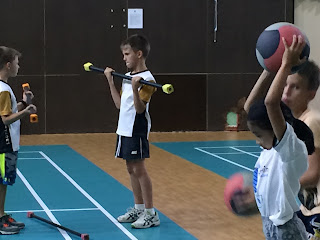
PE students balancing fitness and play!
Want to know more? Check it out...
Kids need to play at school




Note: Comments are moderated and for privacy reasons, cannot include students' names. Please direct specific inquiries via email.
PE students balancing fitness and play!
Want to know more? Check it out...
Kids need to play at school


Note: Comments are moderated and for privacy reasons, cannot include students' names. Please direct specific inquiries via email.
Monday, August 24, 2015
Making the grade with a mind-body connection!

Be Active Your Way
Subscribe to:
Posts (Atom)